William Chester Minor–Oxford English Dictionary relationship
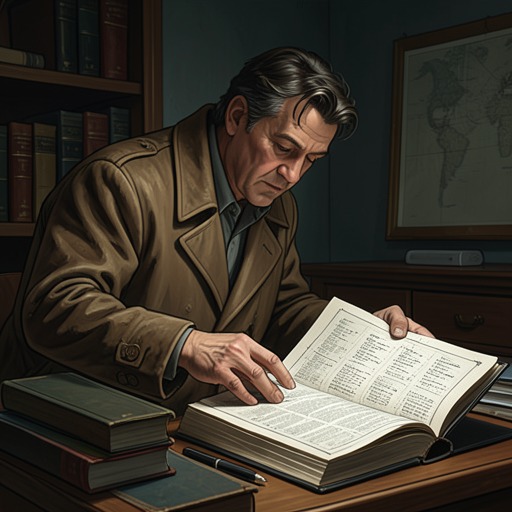
The Surgeon of CrowthorneWilliam Chester Minor’s relationship with the Oxford English Dictionary joined substantial scholarly work to an unusually long personal friendship with its editor, James Murray. Minor became one of the Dictionary’s valued readers while living at Broadmoor Asylum, but Murray did not at first know that his correspondent was an inmate. Their eventual meeting in January 1891 began almost twenty years of regular contact; later retellings shifted that meeting into legend, while the Dictionary itself preserved a more durable record of Minor’s contribution by acknowledging him among its contributors.
A contributor first known by his work
Murray’s account, written in 1902 to Francis Brown, places his first contact with Minor very soon after work on the Dictionary began, probably in 1880 or 1881. Minor proved a very good reader and wrote often. Murray’s early impression was of a retired medical man with abundant time for reading, not of a long-term patient at Broadmoor. The correspondence thus began on the evidence of Minor’s work: his usefulness to the Dictionary was apparent before the circumstances of his life were.
The difference between what the two men knew shaped the relationship’s beginning. Minor was writing from Broadmoor, Crowthorne, Berkshire, but Murray initially assumed that the address might belong to a medical officer at the institution. The mistaken inference did not prevent a sustained exchange; it did mean that the scholarly connection preceded Murray’s understanding of the setting in which Minor lived. In a later account, Murray said the Dictionary owed much to Minor, a judgment that made their eventual acquaintance more than a courtesy visit.
The discovery and the meeting
Murray eventually learned that Broadmoor was a large asylum. The account of his discovery became the point from which later writers built a dramatic first-meeting story, but the surviving evidence places the actual visit in January 1891. Murray had written to Dr Nicholson for permission to visit. His letter anticipates the journey and the pleasure of meeting Minor, while also noting his practical reliance on his wife to work out the train arrangements. The visit was planned, not an accidental arrival at an institution mistaken for a fellow scholar’s home.
The first encounter took place over lunch and began a firm friendship. Murray and Minor saw one another regularly for almost twenty years. Their bond rested on wary mutual respect and, more particularly, a shared passion for words. The friendship connected work conducted through letters with personal meetings at Broadmoor, where Minor’s room and books could be shown to distinguished visitors. Murray’s account also records that Minor gave a large part of his income to support the widow of the man whose death he had caused, and that she visited him regularly: knowledge of this continuing responsibility formed part of the circumstances Murray learned about his correspondent.
A meeting turned into legend
A much more sensational version circulated in 1915. In Hayden Church’s story, Murray set out to visit a fellow scholar and discovered instead that Minor was an American murderer confined in Broadmoor; astonished, he asked to be taken to him. The book identifies this account as an amusing, romantic fiction. Church first published it anonymously in the Washington Sunday Star in July 1915, then ran revised versions in the Strand magazine in September 1915 and six months later. Its dramatic reversal gave the encounter a ready-made shape: the celebrated dictionary editor discovers that his elusive contributor is an asylum inmate.
The story became influential precisely because it was so compelling. Readers and later accounts repeated it, sometimes treating the supposed discovery as fact. The documentary account corrects both the timing and the circumstances: Murray’s first contact with Minor dated to about 1880 or 1881, and they met in January 1891, not at the later date favored by versions associated with the Dictionary Dinner. The distinction matters to their relationship. Their friendship did not begin in a single theatrical revelation; it grew out of years of correspondence and an established record of useful work.
Recognition in the Dictionary
The relationship’s lasting public trace is not the legend but Minor’s place among the Dictionary’s contributors. The Oxford English Dictionary’s large print editions are expensive and bulky, and the book notes that the CD-ROM had become a more convenient alternative. Yet the material format is secondary to the formal acknowledgment: the Dictionary names Minor among those whose work helped make it the major scholarly undertaking it became. Finding his name within that vast record is presented as a particularly affecting discovery, and as an instance of the serendipity associated with dictionaries.
That recognition holds together the two sides of the relationship. Minor was not merely the subject of a remarkable story about confinement, nor simply a correspondent whose circumstances surprised Murray. He was a reader whose sustained contributions mattered to the Dictionary, and a friend whom Murray came to know through visits as well as letters. The later legend made their connection memorable through revelation; the record of their collaboration gives it a firmer significance, grounded in years of shared work and a name retained in the work they helped create.